| CID | 134611881 |
|---|---|
| InChI | InChI=1S/C205H340N60O53/c1-20-114(16)162(261-179(296)128(66-40-46-86-211)235-176(293)135(74-78-155(273)274)243-170(287)125(63-37-43-83-208)241-192(309)148(106-266)257-174(291)126(64-38-44-84-209)234-171(288)129(67-47-87-225-201(215)216)240-185(302)142(98-119-55-29-24-30-56-119)252-187(304)144(100-121-59-33-26-34-60-121)253-189(306)146(102-158(279)280)233-154(272)104-230-167(284)138(94-109(6)7)248-166(283)122(212)93-108(4)5)194(311)231-105-153(271)232-123(61-35-41-81-206)168(285)242-136(75-79-156(275)276)177(294)251-141(97-118-53-27-23-28-54-118)184(301)238-124(62-36-42-82-207)169(286)236-131(69-49-89-227-203(219)220)181(298)263-164(116(18)22-3)197(314)259-160(112(12)13)195(312)246-134(73-77-151(213)269)175(292)237-132(70-50-90-228-204(221)222)180(297)262-163(115(17)21-2)196(313)245-127(65-39-45-85-210)172(289)256-147(103-159(281)282)190(307)254-143(99-120-57-31-25-32-58-120)186(303)249-139(95-110(8)9)183(300)239-130(68-48-88-226-202(217)218)173(290)255-145(101-152(214)270)188(305)250-140(96-111(10)11)191(308)260-161(113(14)15)199(316)265-92-52-72-150(265)193(310)244-133(71-51-91-229-205(223)224)182(299)264-165(117(19)268)198(315)247-137(76-80-157(277)278)178(295)258-149(107-267)200(317)318/h23-34, 53-60, 108-117, 122-150, 160-165, 266-268H, 20-22, 35-52, 61-107, 206-212H2, 1-19H3, (H2, 213, 269)(H2, 214, 270)(H, 230, 284)(H, 231, 311)(H, 232, 271)(H, 233, 272)(H, 234, 288)(H, 235, 293)(H, 236, 286)(H, 237, 292)(H, 238, 301)(H, 239, 300)(H, 240, 302)(H, 241, 309)(H, 242, 285)(H, 243, 287)(H, 244, 310)(H, 245, 313)(H, 246, 312)(H, 247, 315)(H, 248, 283)(H, 249, 303)(H, 250, 305)(H, 251, 294)(H, 252, 304)(H, 253, 306)(H, 254, 307)(H, 255, 290)(H, 256, 289)(H, 257, 291)(H, 258, 295)(H, 259, 314)(H, 260, 308)(H, 261, 296)(H, 262, 297)(H, 263, 298)(H, 264, 299)(H, 273, 274)(H, 275, 276)(H, 277, 278)(H, 279, 280)(H, 281, 282)(H, 317, 318)(H4, 215, 216, 225)(H4, 217, 218, 226)(H4, 219, 220, 227)(H4, 221, 222, 228)(H4, 223, 224, 229)/t114-, 115-, 116-, 117+, 122-, 123-, 124-, 125-, 126-, 127-, 128-, 129-, 130-, 131-, 132-, 133-, 134-, 135-, 136-, 137-, 138-, 139-, 140-, 141-, 142-, 143-, 144-, 145-, 146-, 147-, 148-, 149-, 150-, 160-, 161-, 162-, 163-, 164-, 165-/m0/s1 |
| IUPAC Name | (4S)-5-[[(2S)-6-amino-1-[[(2S, 3S)-1-[[2-[[(2S)-6-amino-1-[[(2S)-1-[[(2S)-1-[[(2S)-6-amino-1-[[(2S)-1-[[(2S, 3S)-1-[[(2S)-1-[[(2S)-5-amino-1-[[(2S)-1-[[(2S, 3S)-1-[[(2S)-6-amino-1-[[(2S)-1-[[(2S)-1-[[(2S)-1-[[(2S)-1-[[(2S)-4-amino-1-[[(2S)-1-[[(2S)-1-[(2S)-2-[[(2S)-1-[[(2S, 3R)-1-[[(2S)-4-carboxy-1-[[(1S)-1-carboxy-2-hydroxyethyl]amino]-1-oxobutan-2-yl]amino]-3-hydroxy-1-oxobutan-2-yl]amino]-5-(diaminomethylideneamino)-1-oxopentan-2-yl]carbamoyl]pyrrolidin-1-yl]-3-methyl-1-oxobutan-2-yl]amino]-4-methyl-1-oxopentan-2-yl]amino]-1, 4-dioxobutan-2-yl]amino]-5-(diaminomethylideneamino)-1-oxopentan-2-yl]amino]-4-methyl-1-oxopentan-2-yl]amino]-1-oxo-3-phenylpropan-2-yl]amino]-3-carboxy-1-oxopropan-2-yl]amino]-1-oxohexan-2-yl]amino]-3-methyl-1-oxopentan-2-yl]amino]-5-(diaminomethylideneamino)-1-oxopentan-2-yl]amino]-1, 5-dioxopentan-2-yl]amino]-3-methyl-1-oxobutan-2-yl]amino]-3-methyl-1-oxopentan-2-yl]amino]-5-(diaminomethylideneamino)-1-oxopentan-2-yl]amino]-1-oxohexan-2-yl]amino]-1-oxo-3-phenylpropan-2-yl]amino]-4-carboxy-1-oxobutan-2-yl]amino]-1-oxohexan-2-yl]amino]-2-oxoethyl]amino]-3-methyl-1-oxopentan-2-yl]amino]-1-oxohexan-2-yl]amino]-4-[[(2S)-6-amino-2-[[(2S)-2-[[(2S)-6-amino-2-[[(2S)-2-[[(2S)-2-[[(2S)-2-[[(2S)-2-[[2-[[(2S)-2-[[(2S)-2-amino-4-methylpentanoyl]amino]-4-methylpentanoyl]amino]acetyl]amino]-3-carboxypropanoyl]amino]-3-phenylpropanoyl]amino]-3-phenylpropanoyl]amino]-5-(diaminomethylideneamino)pentanoyl]amino]hexanoyl]amino]-3-hydroxypropanoyl]amino]hexanoyl]amino]-5-oxopentanoic acid |
| Molecular Formula | C205H340N60O53 |
| Molecular Weight | 4493 |
| Monoisotopic Mass | 4490.5754259 |
| Polar Area | 1910 |
| Complexity | 10700 |
| XLogP | -22.6 |
| Heavy Atom Count | 318 |
| Hydrogen Bond Donor Count | 63 |
| Hydrogen Bond Acceptor Count | 65 |
| Rotatable Bond Count | 161 |
| Physical Appearance | Fine White Lyophilized Powder |
| Stability | Lyophilized protein is to be stored at -20°C. It is recommended to aliquot the reconstituted (dissolved) protein into several discrete vials in order to avoid repeated freezing and thawing. Reconstituted protein can be stored at 4°C |
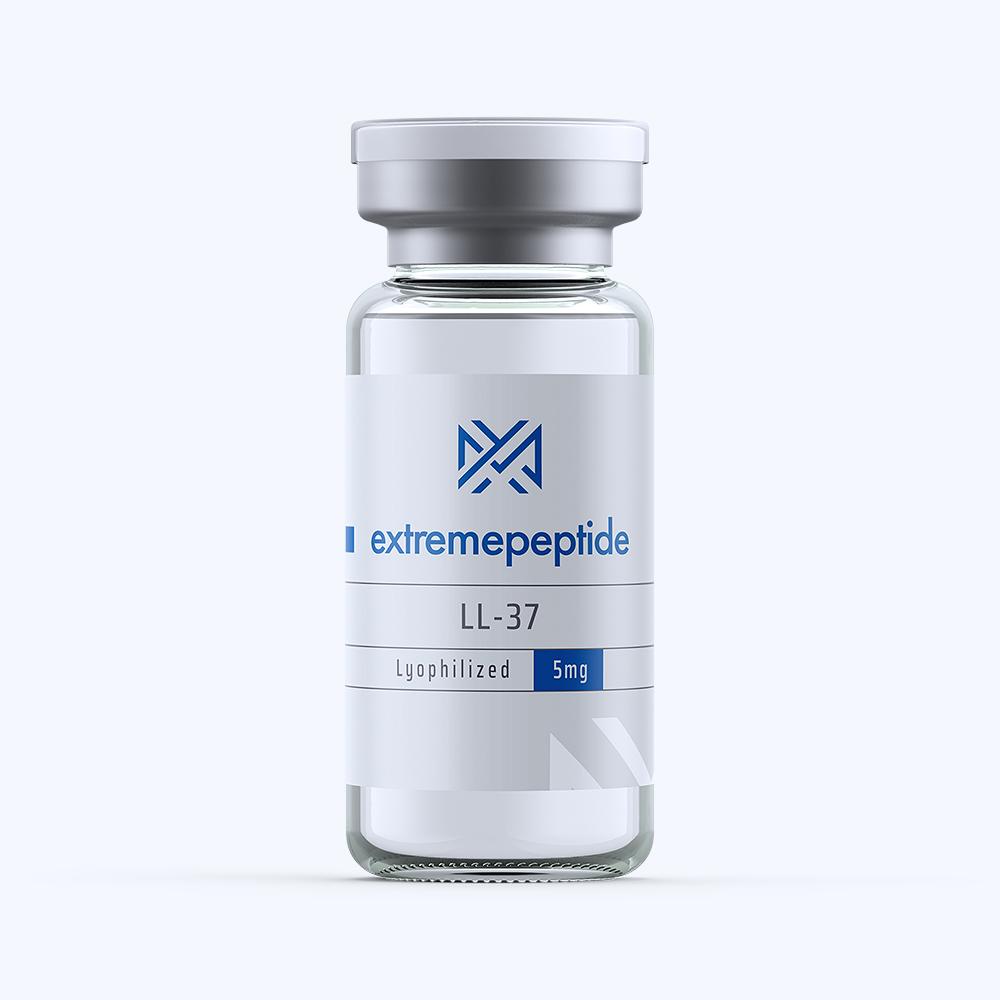
LL-37
Original price was: €99.99.€94.99Current price is: €94.99.
& Free ShippingLL-37: The Antimicrobial Peptide Revolution in Immune Health
Heading 1: What Is LL-37?
LL-37 is a naturally occurring antimicrobial peptide that plays a critical role in the human immune system. It is the only member of the cathelicidin family found in humans and is produced by various cells, including neutrophils, macrophages, epithelial cells, and immune tissues. As part of the body’s innate immune defense, LL-37 acts as a first-line protector against harmful pathogens such as bacteria, viruses, and fungi.
The peptide is generated from a precursor protein known as human cationic antimicrobial protein 18 (hCAP18). Once activated, LL-37 exhibits broad-spectrum antimicrobial activity and helps regulate inflammatory responses. Unlike traditional antibiotics that target specific microorganisms, LL-37 supports the body’s natural defense mechanisms while also contributing to tissue repair and wound healing.
Due to its unique biological functions, LL-37 has become a significant focus of scientific research in immunology, infectious diseases, dermatology, and regenerative medicine. Researchers continue to explore its therapeutic potential for treating various health conditions associated with immune dysfunction and chronic inflammation.
Heading 2: Key Functions and Benefits of LL-37
LL-37 performs several essential functions that contribute to maintaining overall health and immune balance. One of its primary roles is protecting the body from microbial infections. The peptide can directly disrupt the membranes of harmful microorganisms, preventing their growth and survival.
Beyond its antimicrobial effects, LL-37 also serves as an important immune modulator. It helps coordinate immune cell activity, promotes communication between immune pathways, and regulates inflammatory responses. This balanced regulation is crucial because excessive inflammation can damage healthy tissues and contribute to chronic diseases.
Another important benefit of LL-37 is its involvement in tissue regeneration and wound healing. Studies suggest that the peptide supports cell migration, stimulates blood vessel formation, and accelerates the repair of damaged tissues. These properties have generated interest in its potential use for skin conditions, chronic wounds, and post-surgical recovery.
Emerging research also indicates that LL-37 may influence gut health, respiratory health, and the body’s response to viral infections. While ongoing studies continue to investigate these effects, the peptide’s broad biological activity makes it a promising candidate for future therapeutic applications.
Heading 3: LL-37 Research and Clinical Applications
Scientific interest in LL-37 has grown significantly over the past decade. Researchers are investigating its potential role in managing a wide range of conditions, including chronic infections, inflammatory disorders, autoimmune diseases, and skin-related conditions.
In dermatology, LL-37 has been studied for its involvement in conditions such as psoriasis, rosacea, and wound healing. Its ability to regulate immune responses and support tissue repair has made it an important biomarker and potential therapeutic target. Additionally, researchers are evaluating synthetic versions and peptide-based therapies designed to mimic or enhance LL-37 activity.
The peptide has also attracted attention in regenerative medicine due to its ability to promote cellular repair processes. Scientists are exploring innovative approaches that leverage LL-37’s natural healing properties to improve recovery outcomes and support tissue regeneration.
Although research findings are encouraging, many clinical applications remain under investigation. Larger human studies are needed to fully understand optimal dosing strategies, long-term safety, and therapeutic effectiveness across different medical conditions.
Heading 4: Future Outlook of LL-37 in Modern Medicine
The future of LL-37 research appears highly promising as scientists continue to uncover new insights into its biological functions. Advances in biotechnology, peptide engineering, and personalized medicine are expected to accelerate the development of LL-37-based therapies.
One area of particular interest is the growing challenge of antimicrobial resistance. Because LL-37 works through mechanisms that differ from conventional antibiotics, researchers believe it may offer new strategies for combating drug-resistant pathogens. This potential has positioned LL-37 as a valuable candidate in the search for next-generation antimicrobial treatments.
Furthermore, ongoing studies are examining how LL-37 may contribute to immune resilience, inflammatory regulation, and tissue recovery. As understanding of the peptide expands, healthcare professionals and researchers anticipate broader applications across multiple medical specialties.
In conclusion, LL-37 represents a powerful component of the human immune system with diverse biological functions that extend beyond antimicrobial protection. Its roles in immune modulation, wound healing, and tissue regeneration continue to drive scientific interest and clinical innovation. As research progresses, LL-37 may become an increasingly important tool in the development of advanced therapeutic solutions for a variety of health conditions.
Related products
-
KLOW Blend (GHK-Cu, BPC-157, TB-500, KPV)
Original price was: €199.99.€189.99Current price is: €189.99. -
Reta (GLP-1/GIP/GCG) 20mg
Original price was: €359.99.€299.99Current price is: €299.99. -
Thymosin Beta-4 — Full-Length (43 aa; TB-500) 5mg
Original price was: €85.00.€59.99Current price is: €59.99.